The Halo Flight Interface
XR-1 PILOT SYSTEM — BLOCK 2 DEVELOPMENT
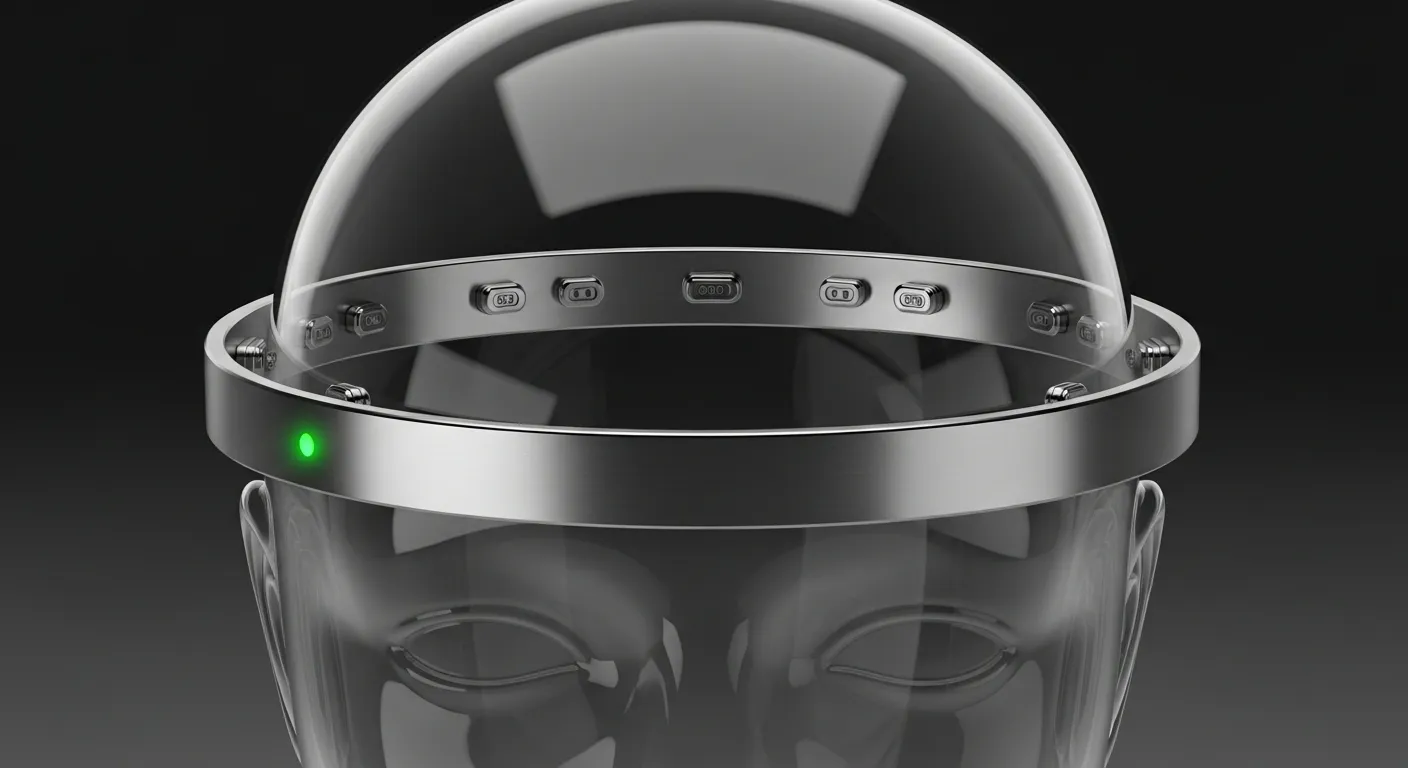
THE HALO FLIGHT INTERFACE — LORENTZ AEROSPACE XR-1 INTEGRATION
The XR-1 has no control surfaces, no throttle lever, no yoke. Its propulsion is distributed across a hull surface controlled by 192 coil currents and 512 THz gyrotron amplitudes simultaneously. A conventional cockpit cannot express the control bandwidth the vehicle requires.
Block 1: Glass Cockpit
The Block 1 XR-1 flies with a conventional glass cockpit and HOTAS interface. The pilot commands heading, altitude, and speed while the onboard reduced-order model handles low-level control allocation.
Block 2: Neural Piloting
A 256-channel dry EEG array supplemented by 64 OPM sensors, optimized for motor cortex coverage. Motor intention decoding maps trained neural signatures to flight primitives: accelerate, decelerate, turn, climb, descend, hover. The pilot commands the outcome. The vehicle computes the physics.
Current total intent-to-command latency: 200–300 ms. Reducing non-invasive BCI latency below 100 ms remains an open research challenge.[14]